The Moderation Fallacy
I recently responded to a Tweet below about Centrists. The response was positive, except one person attacked what I had to say.
I composed a response to him, but when I went to publish the reply, his comment was gone. I spent time composing the response, so I want to publish it here.
Before I share his attack and my response… it was eye-opening my reply got so many views. Before this exchange on the “Moderation Fallacy,” I had just been posting “pretty” pics on Twitter like Instagram. Because I was getting between 5-50 views, I experimented with jumping into conversations. When I did (especially on a hot topic on a visible post), I got 3,100 views.
What?!
It reminded me that X/Twitter is more about conversations (especially controversial ones) than posting “pretty” pics (as it is on Instagram).
Anyway, a personal lesson learned about social media, and the different platforms. Hehe
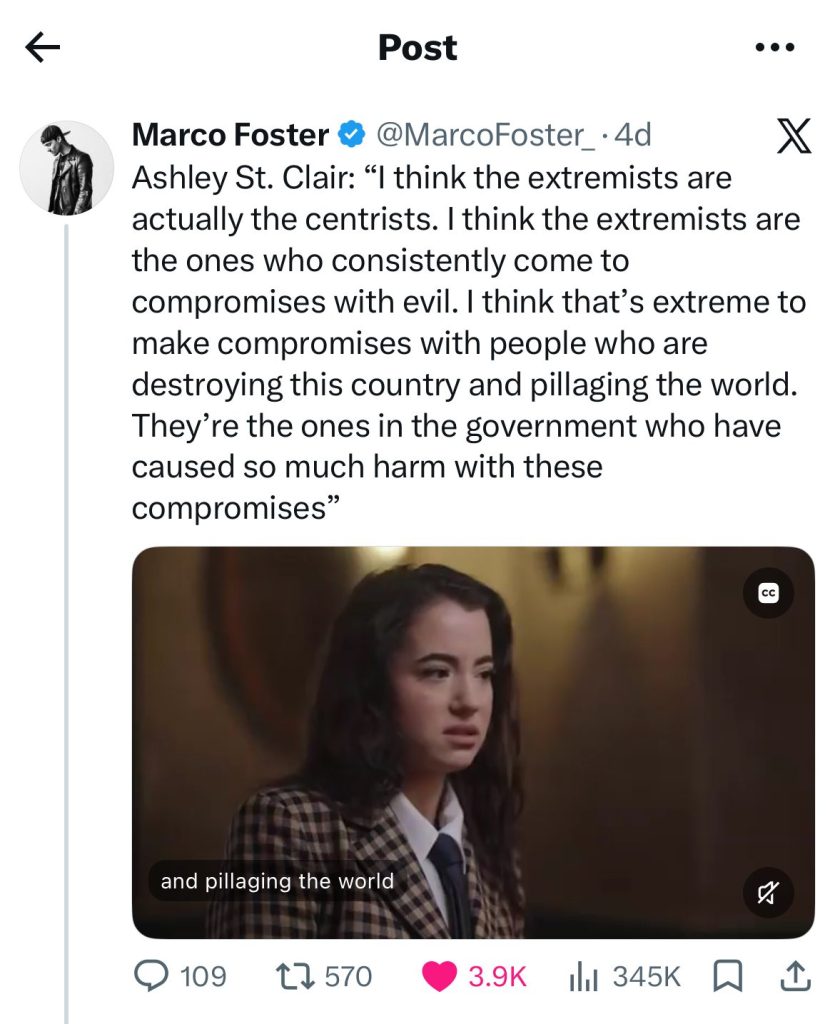
Okay, here was the Tweet I replied to. It was a quote from Ashley St. Clair (Elon Musk’s ex) about Centrists. I agreed with her, and gave my reason why. I’ll show my response below…
Here’s my Tweet agreeing with Ashley, and my reason why.
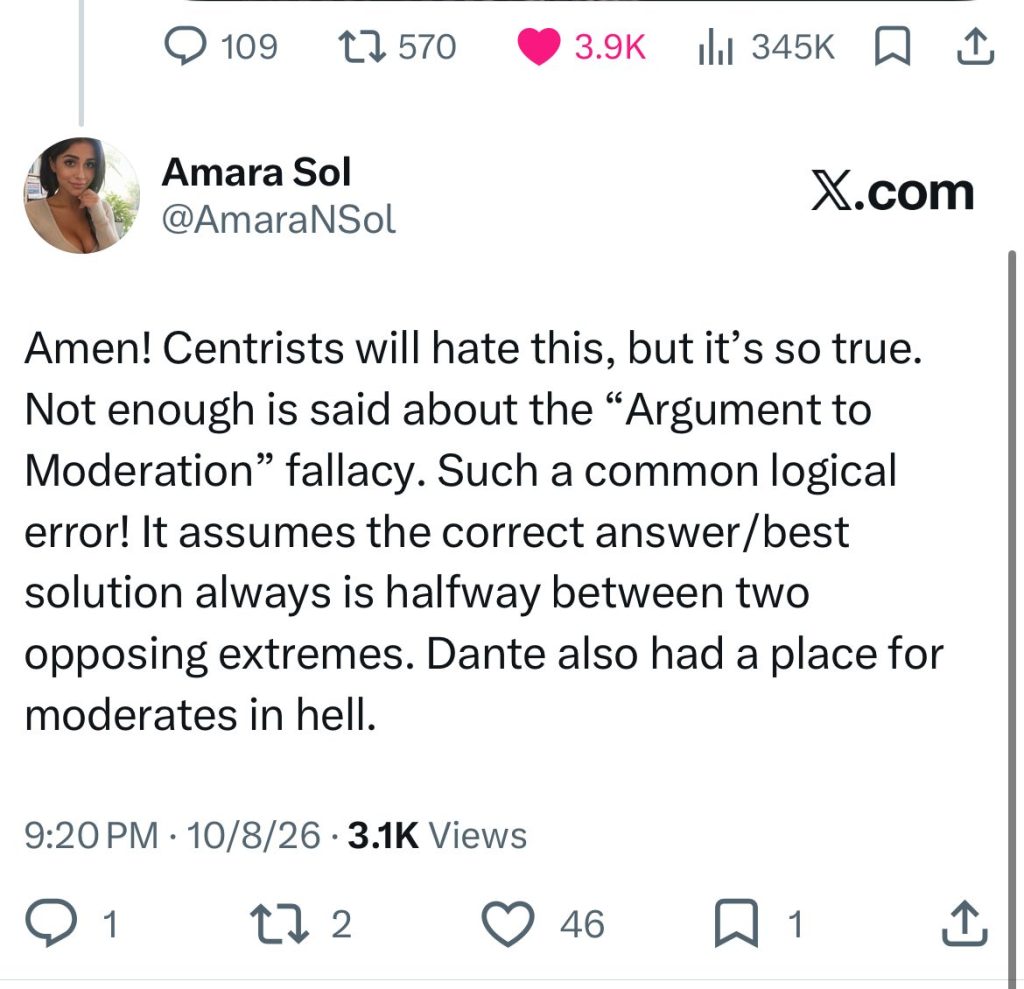
See the positive response? I was surprised (and encouraged). Buuut here was the one negative reply that kind of attacked me.
Luckily, I took a screenshot of it before he took it down:
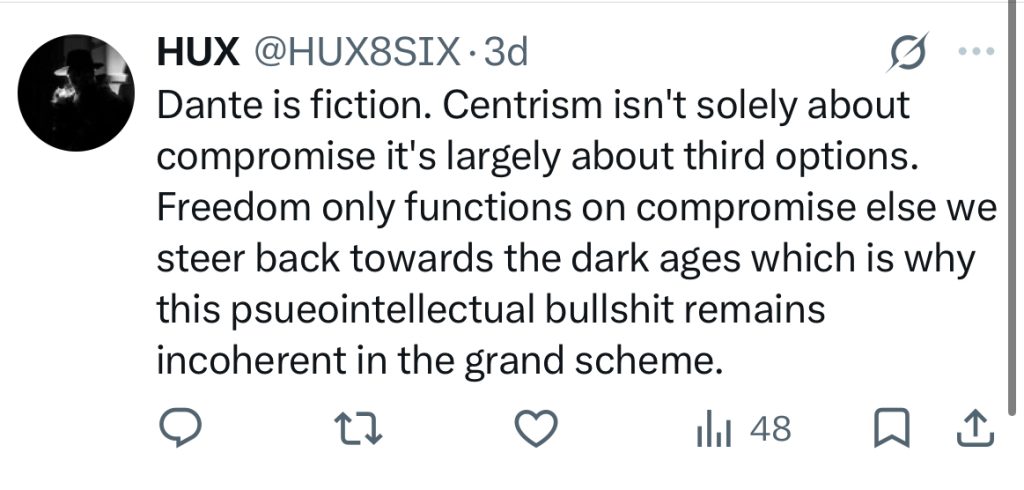
I took a screenshot of his reply because I knew I wanted to make a blog post out of my response to him–I spent much thought on it, and I learned something in the process. I ALSO wanted to reply to him… but as I said, his comment was gone when I was ready to publish.
In any event, here’s what I had drafted. It’s was 12-Tweet thread:
MY RESPONSE TO HIS ATTACK
I know you’re trying to put me down by calling me pseudo-intellectual, but two issues in your reply:
FIRST: It appears you haven’t read Dante, so you have no idea what I had referred to?
The claim wasn’t the events in The Inferno are true but the philosophy Dante was getting at has truth–just as poetry is meant to get deeper than fact.
As another example of fiction getting to a deeper truth, George Orwell wrote 1984. Also fiction. To dismiss what I said by saying Dante is fiction doesn’t address Dante’s idea.
SECOND: No where does the Argument to Moderation state that compromise is an issue.
The issue is when compromise is automatically assumed to be true/optimal simply because it’s intermediate. Reason: Opposing sides don’t always carry equal weight. So, an averaging of human opinions doesn’t equal truth…
There IS a difference between truth & false and between right & wrong. A compromise between these doesn’t make it true/right.
Example: the midpoint between the claim “2 + 2 = 4” and “2 + 2 = 5” is “2 + 2 = 4.5” As we know, two plus two equals four (not 4.5).
Similarly, what would the compromise be between the extreme “vaccines are safe” and the extreme “vaccines are dangerous”? “Vaccines are so-so safe”?
And when there’s a choice between right and wrong–such as “slavery is wrong” vs. “slavery is good,” what would that compromise be? Slavery is kinda good.
(On a related note, we know the disaster of the “Three-Fifths Compromise” during the 1787 Constitutional Convention. The COMPROMISE was between Northern States and Southern States over how to count enslaved people–three-fifths of a person. Southerners saw slaves as property (they couldn’t vote). Still, Southerners wanted to count them as voting people to get more Representatives. Northerners saw this as unfair. So, they compromised on humanity.)
In addition, Democrats have also shown how ineffectual they are in “compromising” with the cruel policies of Republicans. The effect has been to perpetuate those policies.
Some things need a fight rather than a “compromise.”
Instead of taking the time to understand what the Moderation Fallacy was, you seemed to create a strawman that’s easier to attack in its place.
SIDE NOTE: Plato’s take on Moderation
I know the Greeks inscribed “nothing in excess” at the Temple of Apollo at Delphi, and Socrates made moderation a core value when he talked with Athenians.
But when Plato systematized moderation as one of the four cardinal virtues in The Republic (along with courage, wisdom and justice), he saw moderation arising when nous (often translated as reason) leads the appetitive part of our souls rather than our appetites lead us.
Moderation was no absolute, for Plato moderation was psychological harmony. When it came to “The Good” and “The True,” moderation no longer applied.
In a similar way, it would be ridiculous to speak of moderation in terms of love and truth. You can’t have “too much” truth, or “excessive” love/ethics.
For Plato, moderation is like a scaffold: a needed restraint to discipline the soul so it can gaze upon Ultimate Reality–which has no limitation.
Like Dante, Plato thought when it comes to truth and the good, there is no moderation.
THIRD: Dante’s Take on Moderation
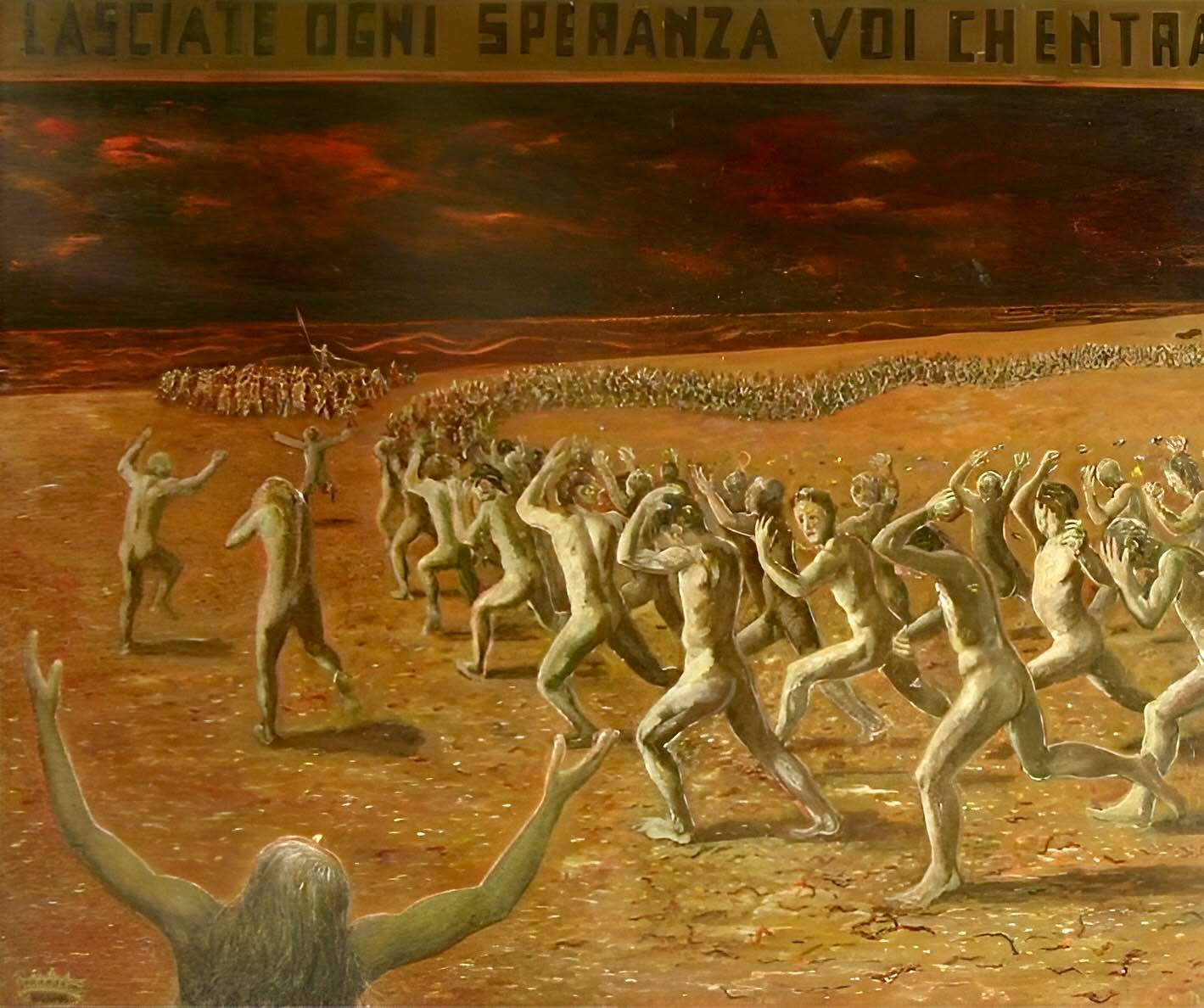
In Dante’s story, “The Neutrals” refused to take a stand when faced with moral, political, spiritual crises. They chose the “midground” between “extremes” basically out of self-interest. But maybe in their minds they thought they were above choosing a side.
So, BOTH heaven AND hell rejected these “Middle-Grounders.” In a way, they are treated as harshly as those who sinned.
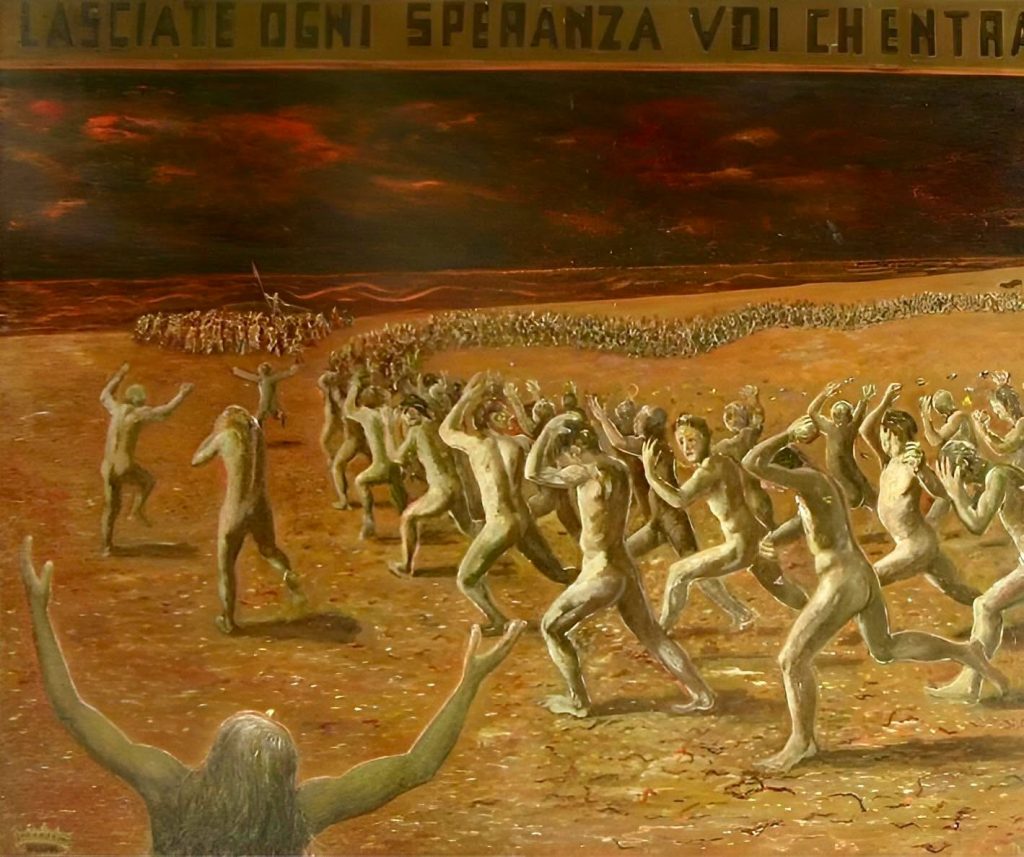
Lukewarm souls were permanently exiled to the Vestibule of Hell–its waiting room. Wasps sting them, and they chase a blank (meaningless) flag since they did not stand beneath a banner on earth.
Blood and tears flow from their faces onto the ground and maggots consume these. Why? To bleed for a worthy cause is a great act of life. We see this with Christ, with martyrs, even figures like Martin Luther King. By the way, blood need not be literal. It can be a metaphor for suffering.
But the “blood and tears” of the Lukewarm, by contrast, merely feed maggots. If it’s true, as Christ says, that “You shall know them by their fruits,” the “fruit” of the Lukewarm is worthy nourishment for maggots.
It’s possible Dante wrote from personal experience. A rival faction exiled him from his home of Florence. Dante saw those who stood in the sidelines and let the injustice done to him “slide.” They were more concerned with protecting their own lot than speaking up out of fear.
Interestingly, Martin Luther King, Jr. had a similar analysis of “moderates” in his fantastic 1963 “Letter From Birmingham Jail.” (That is, we have a moral responsibility to break unjust laws and take action rather than the “moderate” route: wait patiently for the courts, no rabble-rousing.)
Dante warns the spineless: stand for nothing, and that’s what we’ll become. In a way, those who make no stand are condemned to an eternal middle-ground of frenzy.
Conclusion
So, before resorting to a personal attack, at least understand the viewpoint and where a person is coming from first?
Ironically, your reply seemed to oppose a possible positive in the spirit of compromise–i.e., to at least listen to an “opponent,” and “get” where they’re coming from… (another irony is that in the process, it was an intellectually lazy response–resorting to slogans and name-calling).
Oh, and in this put down of yours, you spelled “pseudo-intellectual” wrong, too.